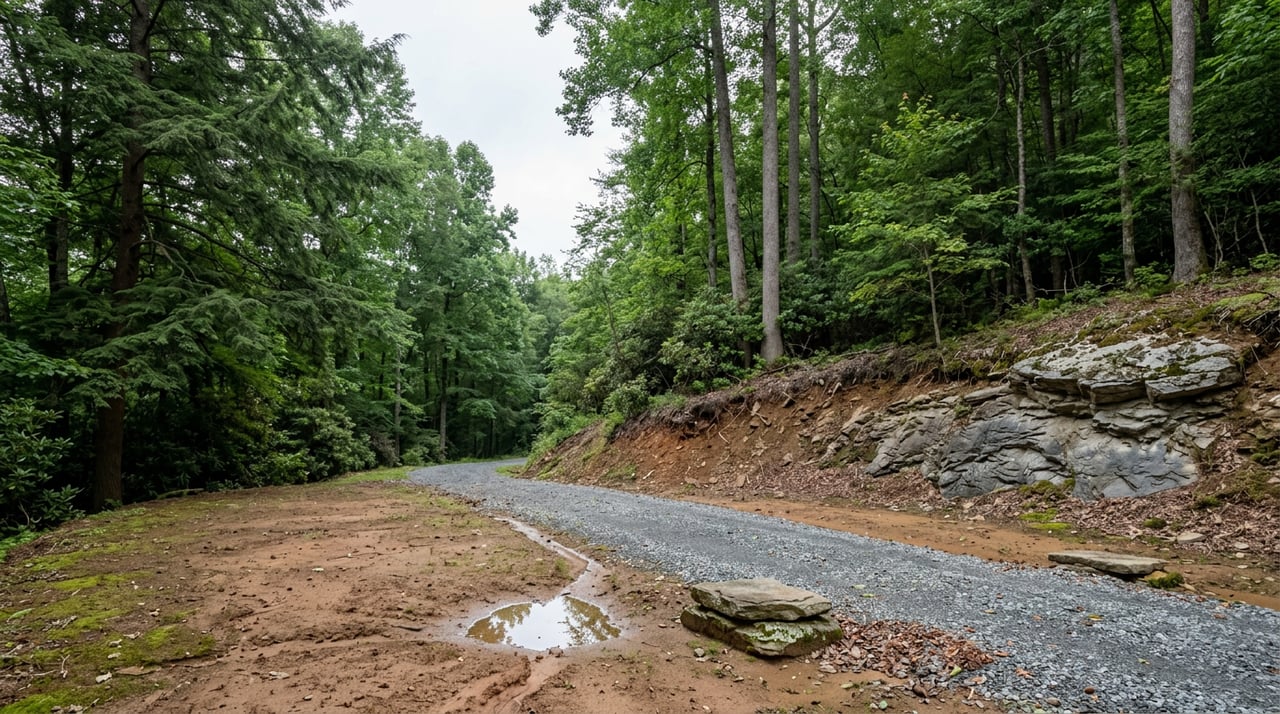
Gatlinburg Land Isn't Priced By The Acre. It's Priced By The Slope.
September 17, 2026
September 17, 2026
A one-acre lot in Chalet Village and a one-acre lot in Settlers Ridge can carry nearly identical asking prices and still leave their buyers tens of thousands of dollars apart by the time a cabin is framed. Same acreage. Same county. Same asking price, even. The gap shows up later, in the grading bill, the septic permit, and whichever side of a zoning line the parcel happens to fall on.
That gap is the thing land buyers underestimate most in this market. Anyone comparing Gatlinburg to the rest of Sevier County by price-per-acre is comparing two different products wearing the same unit of measurement. County-wide land listings currently average around $428,000 per listing, or roughly $67,669 an acre. That number is real, but it's built mostly from larger rural tracts, farms, and acreage plays scattered across the county. Gatlinburg's own land market runs on a different scale entirely: smaller, steeper parcels close to the national park boundary, where a June 2026 market snapshot put the median list price closer to $127,000. Neither number is wrong. They're just not describing the same kind of dirt.
For a buyer trying to pencil out a cabin build or an STR investment, that distinction matters more than the raw price tag. Here's what actually determines whether a Gatlinburg lot is a good deal.
Ask any builder who has worked a hillside lot in this part of Tennessee and the answer is consistent: slope, access, and utility availability drive the real cost of a Gatlinburg parcel far more than the number of acres on the deed. A gentle half-acre can out-build a steep five-acre tract, because the steep tract needs an engineered foundation, a longer driveway cut into the hillside, and a bigger septic budget before a single wall goes up.
That's the mechanism buyers miss when they shop by price-per-acre. Three variables do most of the work:
Listings in named communities across the area show how much this variation looks in practice. A dual-lot parcel in Chalet Village totaling just over an acre gets marketed on its established infrastructure and neighborhood standing. A homesite on Maple Hill Way, just under an acre, gets marketed on privacy and mountain views instead. An unrestricted lot in Settlers Ridge gets marketed on flexibility, meaning the buyer decides the build without a covenant dictating it. Three lots, three different value propositions, none of them reducible to a single per-acre figure.
| Location type | Typical utility access | What that means for build cost |
|---|---|---|
| Gatlinburg proper, established subdivisions | City water and sewer often reach the lot | Lower site-prep cost, faster permitting timeline |
| Mountain parcels outside city core | Well and septic serve most lots | Soil evaluation required before design; septic system is a real line item, not an afterthought |
| Steep or remote tracts | Utilities may require extension | Longer driveway cuts, retaining walls, and engineered foundations add to the number before the cabin itself is priced |
A buyer running numbers off a listing sheet alone will miss all three rows. The acreage and the asking price are visible. The utility map and the slope are not, and they're what actually separate a $150,000 lot that's ready to build from a $150,000 lot that needs another $40,000 to $60,000 in site work before it's the same thing.
Short-term rental use is broadly allowed across most of unincorporated Sevier County. That fact gets repeated often enough that it starts to sound like a blanket answer. Inside Gatlinburg's city limits, it isn't one. Zoning and overlay districts control whether a specific parcel can be used as a short-term rental at all, and that determination happens at the parcel level, not the city level.
A 5.16-acre development opportunity currently listed on Glades Road, inside Gatlinburg's Great Smoky Arts & Crafts Community, illustrates why this matters. That parcel carries its own neighborhood and zoning context, separate from a similarly sized tract on the other side of town. A buyer evaluating two lots that look identical on a map, similar acreage, similar price, similar distance to downtown, still has to check each one's specific zoning and overlay status rather than assuming they carry the same STR eligibility.
The fix isn't complicated, but it does require doing it before the offer goes in, not after.
None of these steps show up on a standard listing sheet. All five change what a lot actually costs to turn into a rentable cabin.
One number does work in the land buyer's favor here. Sevier County's property tax rate sits at roughly 0.31 percent, well below the national average. For a buyer who wants to acquire a lot now and build later, whether waiting on permits, financing, or simply market timing, that low carrying cost matters. It means holding raw land in this market for a year or two while due diligence gets sorted out doesn't erode the investment the way it would in a higher-tax market. Land near the boundary of the country's most-visited national park is also structurally scarce. It can't be manufactured, and buildable view parcels in established rental corridors have appreciated accordingly.
That combination, low holding cost and structural scarcity, is part of why land in this corridor keeps attracting both owner-builders and portfolio investors. It's also exactly why getting the slope, the septic, and the zoning answer right before closing matters more here than in a market where land is easier to come by.
Does short-term rental eligibility transfer automatically when I buy a lot? No. STR use depends on the parcel's specific zoning and any applicable overlay district. A lot's eligibility should be confirmed by parcel, not assumed from general statements about county-wide rental friendliness.
Is septic always required, or does city sewer reach most Gatlinburg lots? It depends entirely on location. Parts of Gatlinburg proper have city water and sewer access. Most mountain parcels outside that core rely on wells and septic, which means a soil evaluation is a necessary early step rather than a late one.
Why does a steep lot cost more to build on than a flat one of the same size? Slope drives foundation engineering, driveway length, retaining wall needs, and septic system design. On steep ground, all four of those add cost before the cabin itself is priced, which is why acreage alone is a poor predictor of total project cost in this market.
Land in the Smokies rewards buyers who ask the right questions before the offer, not after the survey comes back. If you're evaluating a parcel in Gatlinburg or comparing it against options elsewhere in Sevier County, Kristi Street can walk the lot with you, help you understand what the slope and utility map actually mean for your build budget, and confirm the zoning picture before you're under contract. Request a consultation and home valuation to start with a clear read on what a specific parcel will actually cost to build.
Stay up to date on the latest real estate trends.
With over 20 years of experience in the Smoky Mountains market, I help buyers, sellers, and investors navigate resort and residential real estate with confidence. My background in short-term rentals gives my clients a strategic edge—from zoning and income potential to identifying properties that truly fit their goals. I approach every transaction with integrity, transparency, and careful attention to detail, so you can move forward informed, protected, and positioned for long-term success.
Let's Connect
405 Boyds Creek Hwy Seymour, TN 37865